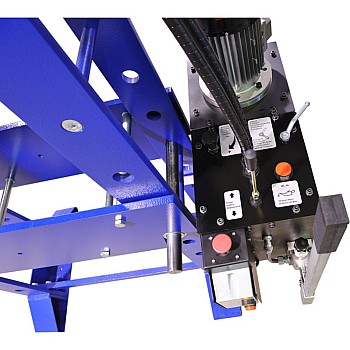
Industrial hydraulic presses
Hydraulic presses are universal machines generating high force, designed for various metal forming, bending, straightening, pressing, or assembly tasks. Due to their pressure capacity, structural strength, and functionality, they are widely used in manufacturing, metalworking, transportation, heavy industry, and maintenance sectors.
BDS.lt offers industrial presses that are reliable, meet professional work requirements, and comply with safety standards.
Where are hydraulic presses used?
In metalworking shops – for sheet bending, profile forming, part pressing
In transport and heavy machinery repair workshops – for straightening parts, bearing pressing, axle assembly
In industrial plants – for stamping, bushing insertion, or other force-demanding operations
In tool manufacturing and maintenance – for precise forming or restoring of metal components
Assortment features
Portal presses (up to 160 t) – for bending or straightening large parts, with mechanically movable frames for flexible operation
C-type presses – more compact and robust, for central pressing and precise bushing insertion
Horizontal presses with NC control – ideal for profile bending or production where exact angle setting is required
Hydraulic profile bending machines – specialized equipment for pipe and profile bending with digital control
Why choose a hydraulic press from BDS.lt?
High pressure accuracy – ensures stable results even in complex operations
Safety – machines meet CE standards, equipped with safety valves and emergency stop functions
Performance – suitable for both single operations and series production
Wide power range – from 20 to 160 tons and more
Frequently asked questions (FAQ)
Which type of press to choose: C-type, portal, or horizontal?
– C-type is suitable for compact, central operations (bearings, bushings, pressing)
– Portal is for large parts, straightening, when flexibility of the working zone is required
– Horizontal is for bending or forming profiles in one line
What does “mechanical shifting” mean in portal presses?
It means the pressing head can be mechanically moved horizontally, allowing larger parts to be processed in different zones without repositioning the workpiece.
What is the minimum pressing force required for repairs (e.g., bearings, axles)?
For repair tasks, 20–50 t presses are usually sufficient. For industrial bending or forming – 100–160 t or more.
Can the pressure be adjusted?
Yes. All presses are equipped with pressure regulation valves, and some include manometers for precise work.
What maintenance does a hydraulic press require?
Regularly check hydraulic oil levels, monitor valve condition, and maintain the working surface (lubricate, clean from dust/metal chips).
%20Profi%20Punch%2010%20RHTC-350x350.webp "10 ton mechanical punching press Profi Punch 10 RHTC")
%20Profi%20Punch%2010%20RHTC.1-350x350.webp "10 ton mechanical punching press Profi Punch 10 RHTC")