


Sandblasters
Sandblasters are versatile and mobile devices designed for various cleaning, paint, rust, or old coating removal tasks from metal, stone, concrete, wood, or glass surfaces. These sandblasting machines are ideal for professional use in auto services, industrial applications, and for individual users performing restoration or repair work in their workshops.
Why choose a sandblaster?
- Efficient surface preparation – sandblasting significantly shortens grinding or cleaning time.
- Compact and mobile – most models are equipped with wheels, making them easy to move.
- Simple design – quick setup and convenient operation.
- Wide application range – suitable for small parts as well as larger metal surfaces.
- Product range features
The BDS.lt catalog offers sandblasters with:
- Capacities from 19 to 215 liters – suitable for both short and long-duration work.
- Mobile models – ideal for on-site use or where no fixed workspace is available.
- Units with vacuum function – for dust collection (in some models).
- Kits include nozzles, hoses, protective gloves, and pressure gauges.
- Compatible with different abrasives – from quartz sand to slag or glass beads.
Who is it for?
- Auto services restoring wheels, brake discs, suspension parts, or engine components.
- Metalworking companies removing rust, old coatings, or preparing surfaces for painting.
- Individual users restoring vintage furniture, machinery, or building surfaces.
Frequently asked questions (FAQ)
What is the difference between a sandblaster, sandblasting cabinet, and dust-free unit?
A sandblaster is a mobile, open device designed for outdoor or semi-enclosed work. Unlike a cabinet, it doesn’t have dust isolation, and it differs from a dust-free unit by lacking a vacuum system.
Is a compressor required for a sandblaster?
Small sandblasters require at least 170 l/min, though using a 700 l/min compressor ensures sufficient pressure for the abrasive flow.
What abrasive should be used?
It depends on the surface – quartz sand is most common, but slag, glass beads, walnut shells, or soda can also be used. Always ensure compatibility between the abrasive and the surface.
Are these devices suitable for home use?
Yes, smaller models (e.g., 19–20 liters) are ideal for garages or yard work, provided a suitable compressor is available.
How long does the sandblasting process take?
It depends on the surface condition, abrasive type, pressure, and tank capacity. For example, a 75-liter sandblaster allows longer operation without refilling, making it suitable for medium-intensity work.
-350x350.webp "Mobile sandblaster 19 L Castex")
-350x350.webp "Mobile sandblaster 19 L Castex")
-350x350.webp "Sandblaster 75 L")
-350x350.webp "Sandblaster 75 L")
-350x350.webp "Mobile sandblaster 63 L SB-63 Redats")
-350x350.webp "Mobile sandblaster 63 L SB-63 Redats")
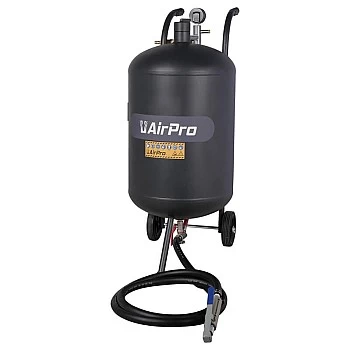
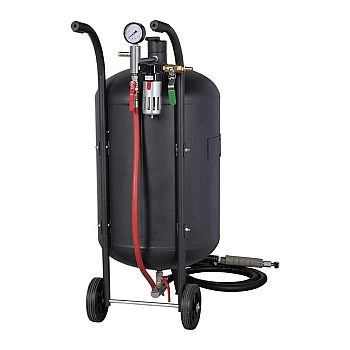

-350x350.webp "Sandblasting kit BlastPack 25 Contracor")
-350x350.webp "Sandblasting kit BlastPack 25 Contracor")
-350x350.webp "Sandblasting kit BlastPack 50 Contracor")
-350x350.webp "Sandblasting kit BlastPack 50 Contracor")


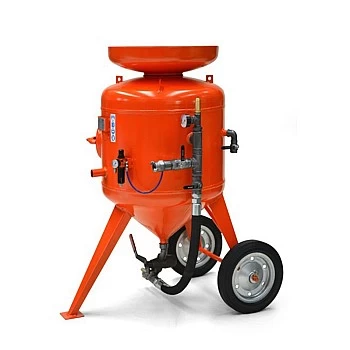
-350x350.webp "Sandblasting kit BlastPack 100 Contracor")
-350x350.webp "Sandblasting kit BlastPack 100 Contracor")
-350x350.webp "Sandblasting kit BlastRazor-2-200RC Contracor")
-350x350.webp "Sandblasting kit BlastRazor-2-200RC Contracor")