


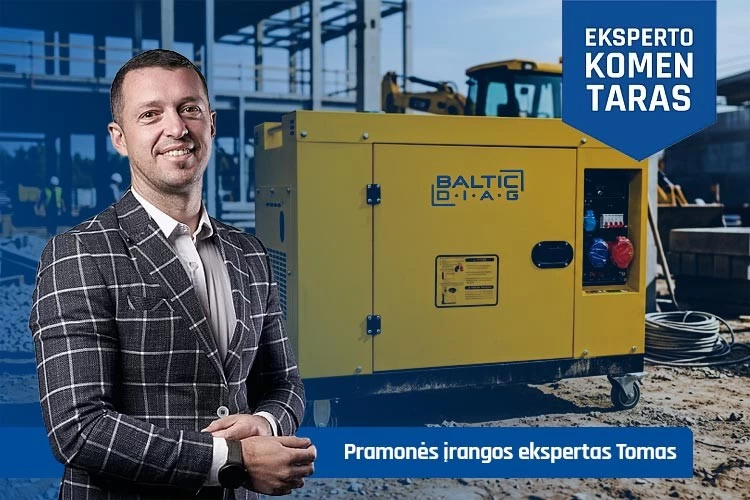
Generator selection: which generator to choose and what mistakes to avoid?
A power outage is rarely just a minor inconvenience. On a
construction site, it can mean stopped work, delayed deadlines and additional
costs. In production, it means interrupted processes, downtime and financial
losses. At home, it can cause discomfort, a non-functioning heating system,
damaged household appliances or interrupted remote work.
That is why a generator should not be purchased only based
on price or “how many kilowatts are written in the description”. A properly
selected generator must match the actual electricity demand, frequency of use,
type of connected equipment and working conditions. The right choice today
means lower risk, fewer interruptions and greater peace of mind when the power
goes out.
Why is it important to choose a generator based on real needs?
A common mistake is choosing a generator only by its rated
power. For example, if a device is marked as having a power rating of 2 kW, it
does not necessarily mean that a 2 kW generator will be enough. Some devices
require significantly more power for a short time during start-up than during
normal operation.
This is especially relevant if you plan to power:
- compressors;
- pumps;
- refrigeration equipment;
- electric motors;
- construction tools;
- heating or water supply systems.
During start-up, such devices may require 2–3 times more
power than indicated on their technical label. Therefore, a generator should be
selected not only by the total operating power of the devices, but also by
taking the start-up load into account.
Petrol or diesel generator?
One of the first questions when choosing a generator is
which fuel type is best suited to your usage scenario. Petrol and diesel
generators solve the same problem, but they differ in purpose, operating
intensity and long-term running costs.
Petrol generators
A petrol generator is usually chosen when electricity is
needed periodically or for shorter periods of time. It is a practical solution
for backup power at home, for a countryside property, outdoor trips, small
outdoor tasks or short-term construction work.
We recommend choosing petrol generators for:
- backup power at home;
- country houses and garages;
- short-term construction or repair work;
- small gardening and household tasks;
- situations where the generator is not used every day.
Main advantages of petrol generators:
- lower initial investment;
- easier starting in the cold season;
- often lower noise level;
- a suitable choice for less frequent use.
A petrol generator is a good choice when the main priority
is to have a reliable backup power source, but the unit will not be used for
many hours every day.
Diesel generators
Diesel generators are more often chosen where electricity is
needed intensively, for long periods and on a regular basis. This is a solution
for professional use: production, construction, infrastructure facilities,
agriculture or businesses where power supply interruptions can be expensive.
We recommend choosing diesel generators for:
- manufacturing companies;
- larger construction sites;
- industrial facilities;
- agriculture;
- infrastructure and service facilities;
- long-term or daily use.
Main advantages of diesel generators:
- durability;
- lower fuel consumption in long-term operation;
- better suitability for higher and continuous loads;
- reliable operation in more demanding conditions.
A diesel generator usually pays off when the unit is used
frequently and the most important criteria are durability, operating time and
the ability to handle higher loads.
Generator mobility: where and how will it be used?
Another important selection criterion is generator mobility.
One customer may need a compact unit that can be placed in the boot of a car.
Another may need a powerful generator with wheels that can be moved around a
construction site. A third may need a high-power solution mounted on a trailer,
ready to be transported between different sites.
Portable or compact generators
Portable generators are suitable when electricity is needed
here and now, but there is no space for a large unit. This is a practical
choice for technicians, country house owners, camper users or small household
tasks.
Where are they most often needed?
- When electricity is needed in a remote location, but a large
generator would be an impractical choice.
- Advantages of portable or compact generators:
- easy to transport;
- fits into a car or a small storage area;
- suitable for technicians visiting clients;
- convenient for small jobs in the garden, garage or country
house.
Mobile generators with wheels
Mobile generators with wheels are designed for situations
where more power is required, but the unit needs to be moved around the site.
This is relevant on construction sites, in workshops, farms and production
areas.
Where are they most often needed?
When a more powerful electricity source is required, but the
generator should not become a difficult-to-move piece of equipment.
Advantages of mobile generators with wheels:
- a good balance between power and mobility;
- convenient to move even by one person;
- a stronger frame protects the unit in intensive working
environments;
- suitable for professional use in construction or workshops.
Generators on trailers
Generators on trailers are used when high power is required
together with the ability to quickly transport the unit to different sites.
This is a solution for road construction, events, industrial facilities or
emergency situations.
Where are they most often needed?
- When delivering a high-power electricity source to a site
becomes complicated and requires additional logistics.
Advantages of generators on trailers:
- high power on a mobile platform;
- can be transported between sites;
- best suited for infrastructure, events and industrial needs;
- ready to use where the power grid is unavailable or
unreliable.
Which technical generator specifications must be evaluated?
Generator power
When choosing a generator, it is important to evaluate not
only the total power of the devices, but also their start-up load. If equipment
with electric motors will be connected to the generator, rated power alone may
not be enough.
What generator power should you choose?
- list all devices you want to power with the generator;
- evaluate their operating power;
- separately mark devices with motors, pumps or compressors;
- allow additional power reserve for such equipment;
- choose a generator not “at the limit”, but with a safe
reserve.
For example, if you want to power a refrigerator, a pump,
lighting and a boiler controller, you need to evaluate not only their operating
power, but also how much power will be required during start-up. A generator
that is too weak may fail to start the equipment or may operate unstably.
Do not forget the automatic voltage regulator
AVR, or automatic voltage regulator, ensures stable voltage
during generator operation. This is especially important if you plan to connect
electronics that are sensitive to voltage fluctuations.
An automatic voltage regulator is relevant if the generator
will power:
- computers;
- boiler controllers;
- security systems;
- automation equipment;
- communication equipment;
- sensitive household appliances.
Without voltage regulation, sensitive devices may be damaged
by voltage fluctuations. Therefore, for home backup power, offices or equipment
with electronic controllers, it is recommended to choose a generator with an
automatic voltage regulator (AVR).
Single-phase or three-phase generator?
Another common mistake is buying a three-phase generator
simply because it seems “more serious”. If only single-phase devices will
normally be used, a three-phase generator is not necessarily the better choice.
A single-phase generator is suitable when standard 230 V
devices are used:
- household appliances;
- lighting;
- computers;
- electric tools;
- boiler controllers;
- small pumps or compressors.
A three-phase generator is required when you have 400 V
equipment:
- industrial equipment;
- three-phase motors;
- higher-power compressors;
- production machinery;
- often construction or agricultural equipment.
If mostly single-phase devices are connected to a
three-phase generator, there may be a risk of phase imbalance. This means that
the generator’s power will not be used efficiently, and in some cases voltage
stability problems may occur. Therefore, the number of phases should be
selected according to the specific equipment being used, not theoretical power.
The most common mistakes when choosing a generator
1. Too little power
If a generator is selected without a power reserve, it may
fail to start some devices or may operate under constant load. This increases
the risk of faults and shortens the service life of the unit.
2. Start-up load is not considered
Devices with motors may require several times more power
during start-up. This is one of the most common reasons why a generator that
seems “sufficient” in theory does not perform as expected in real conditions.
3. Incorrect fuel type selection
If the generator will be used rarely, a petrol model is
often more economical in terms of initial investment. If the unit will be used
frequently and for long periods, a diesel generator is usually the more
practical option in the long term.
4. A three-phase generator is purchased without a real need
A three-phase generator is required when three-phase
equipment is used. If most of the devices are single-phase, it is better to
choose a properly selected single-phase model.
5. The automatic voltage regulator (AVR) is overlooked
If the generator will be used to power sensitive
electronics, voltage stability is critically important. In such cases, a
generator with AVR is a safe choice.
When is it worth consulting specialists when choosing a generator?
If the generator will be used only for a few simple devices,
the choice can be fairly straightforward. However, if you need to power a
heating system, pumps, compressors, production equipment or a construction
site, it is worth evaluating the loads accurately.
A specialist consultation helps avoid two costly mistakes:
- a generator that is too weak and will not perform its
function;
- a generator that is too powerful and costs more than
necessary without providing real benefit.
A properly selected generator is not just a backup device.
It is electricity supply security, a lower risk of downtime and reliable
operation when the main power grid is not working.
Visit the generator catalogue and choose reliable equipment
with a warranty: Generators
If you are not sure how to accurately calculate the required
power, contact us – our experts will select a generator according to your needs
and equipment specifications.