

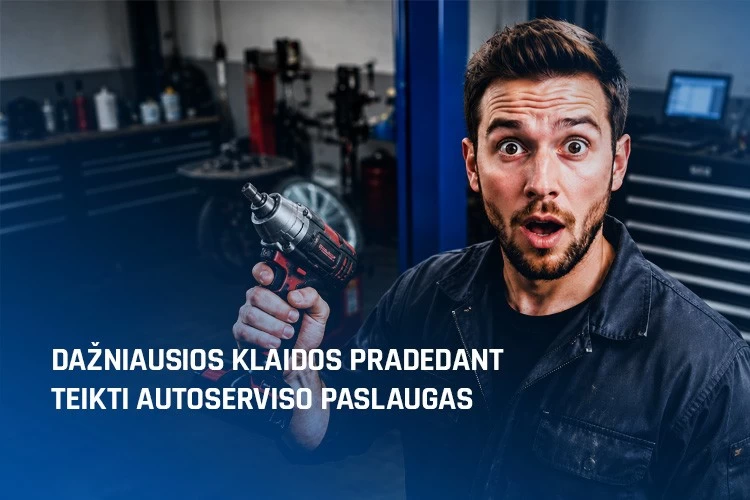
For many people, car repair starts quite simply: maintaining their own vehicle, helping a friend, doing small repairs in the garage, and wanting to better understand automotive technology. Over time, a hobby often grows into a more serious activity. Friends recommend you to other friends, the customer base expands, and more orders start coming in. At the same time, responsibility for work quality, safety, and deadlines also increases.
This is exactly the stage when it becomes clear that
enthusiasm and the tools you already have are no longer enough. To work
efficiently, you need suitable equipment and tools. Both equipment and tools
designed for auto repair shop work help complete jobs faster, reduce the risk
of mistakes, allow you to work more safely, and create a reliable image in the
eyes of customers. Most importantly, professional auto repair shop equipment
gives you the ability to work more efficiently and more profitably.
Beginners often face the same question: where should they
start? Should they buy a vehicle lift first? Should they invest in expensive
diagnostic equipment? Is it worth buying tire changing machines and an air
conditioning service station right away? The answer depends on what services
you plan to provide, what premises you will work in, and what customer flow you
expect to serve.
Where should you start when planning a workshop?
Before buying any service equipment, you first need to
clearly assess the nature of your work and services. One type of equipment will
be needed if you plan to perform suspension, brake, oil change, or other minor
repair work. Another type will be needed if you want to specialize in vehicle
diagnostics, tire fitting, air conditioning service, or more complex work such
as ADAS system calibration or body repair.
The first practical recommendation is to write down the
services you will definitely provide from the start of your business. This
helps separate essential equipment from equipment that may only be useful in
the future. A common mistake is buying many different pieces of equipment
simply because they seem like they will be needed, even though in reality they
will remain almost unused most of the time.
It is also very important to evaluate the premises. A
vehicle lift requires suitable ceiling height, a strong floor, and convenient
vehicle access. A compressor requires space, a suitable electrical connection,
and noise control. Workbenches, tool trolleys, and storage solutions should be
arranged so that the technician does not have to constantly walk back and forth
looking for tools.
We recommend investing first in equipment that directly
affects work quality, safety, and daily productivity. It is better to have less
equipment, but equipment that is reliable and correctly selected, than to have
a workshop full of cheap, inconvenient, or unsuitable tools.
Auto repair shop equipment that is difficult to work without
Vehicle lift
A vehicle lift is one of the most important pieces of
equipment for car repair work. It is needed for suspension, brake, exhaust
system, oil change, and many other jobs. Working underneath a car without a
suitable lift is not only inconvenient but can also be unsafe.
A vehicle lift is worth buying when you plan to regularly
perform repair work underneath vehicles. For a beginner workshop, two-post
lifts or scissor lifts are usually the most relevant options, depending on the
premises, type of work, and available space.
When choosing a vehicle lift, it is important to evaluate
lifting capacity, lifting height, structural stability, locking system, arm
length, and suitability for servicing different vehicles. If you plan to
service electric vehicles, vans, or heavier vehicles, you should assess in
advance whether the selected model will be suitable not only for today’s work
but also for future needs.
Air compressor
An air compressor is used very often in an auto repair shop.
It is needed for pneumatic tools, tire inflation, cleaning, painting, and
technical maintenance work. This is one of those devices whose absence quickly
begins to limit your working capabilities.
A compressor is worth buying at the initial stage of setting
up the workshop, especially if you plan to use pneumatic tools or provide tire
fitting services. When choosing a compressor, it is important to consider air
output, receiver tank capacity, working pressure, electrical connection, and
noise level.
One of the most common mistakes is choosing a compressor
with insufficient output. In that case, tools operate inconsistently, the
compressor works almost without stopping, wears out faster, and prevents smooth
work.
Vehicle diagnostic equipment
In a modern auto repair shop, vehicle diagnostic equipment
is a necessity. Repair work often begins with vehicle diagnostics and reading
fault codes. Vehicle diagnostic equipment is used for programming and pairing
various control units, performing service functions, coding components, and
carrying out other maintenance and repair tasks.
Diagnostic equipment is worth buying if you plan to work
with faults in electronics, engine management, brakes, airbags, transmissions,
or other vehicle systems. A beginner workshop does not necessarily need to
choose the most expensive diagnostic device immediately, but it is important
that the device supports the most popular vehicle brands, has a clear user
interface, and receives regular software updates.
When choosing diagnostic equipment, you should also consider
the scope of functions, vehicle model compatibility, additional special
functions, licensing conditions, and technical support. A cheap device without
updates can eventually become a limiting factor.
Hand tools and electric tools
Quality hand tools and electric tools are the foundation of
daily work. Wrenches, sockets, screwdrivers, ratchets, torque wrenches,
cordless drivers, impact wrenches, and other tools directly affect work speed
and accuracy.
These tools should be purchased before you start providing
services. It is important not to buy random sets that include many unused tools
while lacking the sizes and tools you actually need. It is better to choose a
practical tool set or tool trolley designed for service work.
A torque wrench is especially important. It is not just an
additional tool — it is essential for jobs where precise tightening torque
matters. Incorrectly tightened wheels, suspension parts, or engine components
can cause serious problems.
Tire changing and balancing equipment
If you plan to provide tire changing services, tire changing
and balancing machines are an essential investment. This is a seasonal but
highly demanded service that can help attract new customers.
This equipment is worth buying when you have enough space,
plan to serve a steady customer flow, and can organize work quickly during the
season. When choosing a tire changing machine, it is important to evaluate the
supported wheel rim size range, the need for an assist arm, suitability for
low-profile tires, and structural strength.
For balancing machines, accuracy, convenient operation,
automatic measuring functions, and stable performance are important. Poor
balancing quality quickly becomes a reason for customer dissatisfaction.
Oil change and other service equipment
Oil change equipment, fluid collection tanks, transmission
oil filling equipment, brake bleeding equipment, and other service devices help
complete work more cleanly and quickly. This is not the most expensive part of
workshop equipment, but it has a major impact on cleanliness, safety, and
efficiency.
This equipment should be planned according to the services
you provide. If oil changes will be one of your main services, professional oil
collection and draining equipment should be purchased from the start. If it
will only be an additional service, some equipment can be purchased in stages.
Do not forget workshop setup
Auto repair shop equipment is not only lifts, compressors,
or diagnostic devices. Workshop efficiency is also strongly influenced by the
working environment. Proper workbenches, tool cabinets, tool trolleys, and a
clear equipment layout help reduce wasted time.
Proper lighting is also essential. Weak or uneven lighting
makes work more difficult, increases the likelihood of mistakes, and tires the
technician. In a workshop, it is worth taking care of both general lighting and
additional mobile lights for specific work areas.
An effective air extraction system is an important part of
every auto repair shop. It helps remove exhaust gases, welding fumes, oil
vapors, and other harmful substances, ensuring a safer and healthier working
environment. Properly selected air extraction equipment not only helps comply
with occupational health and safety requirements but also improves working
conditions, increases employee comfort, and contributes to a professional
workshop image.
Ergonomics and safety must be planned from the very
beginning. Electrical cables, air hoses, tools, and waste must not obstruct
movement. The more organized the working environment, the lower the risk of
accidents and work errors.
The most common mistakes when starting to provide car repair services
- The first mistake is buying equipment that is too cheap or
unsuitable. A low price may seem attractive, but lower-quality equipment often
means slower work, more frequent breakdowns, and limited capabilities.
- The second mistake is investing in unnecessary equipment.
When starting a business, it is important to distinguish between what is needed
every day and what may only be useful in the future. Equipment must serve the
work, not stand unused. Do not forget that equipment and devices used daily
will pay for themselves very quickly.
- The third mistake is not evaluating future needs. If you already plan from the start to work with larger vehicles, electric vehicles, or a wider range of services, equipment should be chosen with a certain reserve. Equipment that is outgrown too quickly means additional expenses.
- The fourth mistake is forgetting about maintenance and spare
parts. Even good equipment needs to be maintained. That is why it is important
to choose a supplier who can provide consultation, warranty service,
maintenance, and the necessary spare parts.
- The fifth mistake is not consulting specialists who
understand this field. Specialists will save your time when choosing equipment,
devices, or tools. They will advise you on what is important to consider,
helping you avoid additional expenses in the future.
What do our service equipment specialists recommend?
If you want to turn your car repair hobby into a successful
business, first invest in equipment that ensures safe and efficient work. Most
often, this includes a vehicle lift, air compressor, essential hand and
electric tools, diagnostic equipment, and other specialized service equipment.
More customers serviced means higher profit.
Tire changing and balancing equipment is worth buying when
you have sufficient customer flow for this service.
Before buying, it is always worth consulting auto repair
shop equipment specialists. This helps evaluate your needs, premises,
electrical connection, type of work, and budget more accurately. Proper
consultation often helps avoid costly mistakes — both buying insufficient
equipment and buying equipment that is too expensive or practically
unnecessary.
Turn your passion into a successful business!
Properly planned investments allow you to work more
efficiently, more safely, and more professionally. Most importantly, they help
build a strong foundation so that a car repair hobby can become a stable,
growing, profitable activity that earns customer trust.